Okay, I admit it. I was a big fan of Eureka, not least because the show’s heroes (and villains, and, for that matter, extras) were smart people. Very smart people.

And while I’d have enjoyed another season or two, the show’s creators were wise enough to know it had run its course. And, having run its course, they showed they knew how they were going to finish the show when they filmed the first episode. (Anything more would be a plot spoiler. Watch it on Netflix and you’ll understand.)

Speaking of series finales, this marks the end of KJR’s series on IT critical success factors. And like any good series finale, it ends as it began — in this case, with relationships.

The series (about IT CSFs, not Eureka) began with how the relationship between IT and the rest of the business is defined and how it’s managed. It ends with team dynamics, inter-team dynamics, and whether every employee in IT feels a sense of ownership when it comes to the business/IT relationship.

Team Dynamics

High on the list of what the best leaders take pride in is their ability to build strong teams.

It turns out that managing team dynamics is a lot like Michelangelo’s technique for crafting his most famous statue … his legendary explanation was that he merely chipped away everything that didn’t look like David.

Sometimes, the best a leader can do is chip away everything that doesn’t look like a strong team — in particular, two team members who can’t seem to get along with each other.

It’s easy when one or both are marginal performers. The best leaders know they’re better off without marginal performers anyway; this is one more justification for replacing them with others who are stronger.

But sometimes two otherwise good employees, often for reasons they can’t even articulate, just rub each other the wrong way. Requiring them to like each other is a non-starter. Hollywood solutions, where they (for example) get lost in the woods and discover each other’s virtues are just that … pretty fictions that rarely happen in non-fiction settings.

The best leaders can do is inform both employees that if they can’t figure out how to work together effectively, one or both will find themselves working somewhere else.

See, teams aren’t comprised of individuals. They’re a collection of relationships, so a seven-person team consists of 21 interpersonal connections (the formula is n(n-1)/2). You might think this means that if two people can’t get along that’s just 1/21 of the team.

But it isn’t, because it doesn’t work that way: If two employees can’t get along they’ll both ask everyone else on the team to choose sides. And as no business process or practice can work without trust among all participants (see “Uncomfortable conversations,” KJR, 9/13/2010 or Chapter 4 of the KJR Manifesto), the more side-choosing that happens, the more team effectiveness will break down.

Good team dynamics energize everyone. Bad team dynamics? They poison the organization.

Inter-team dynamics

In software, objects have a property called “inheritance.” It means that if an object has a property and you use that object to create a new, specialized “child” object, the child inherits the properties of its parent unless and until the programmer overrides them.

Sometimes, teams don’t get along. Not the members of the team, or at least, not yet — the teams themselves. This is unsurprising. Teams define who we are, so anyone on another team starts out with the onus of being they.

And you know what they‘re like. Them-ness is never good.

When it comes to us-vs-them relationships, team members inherit the properties of the team.

The tendency to divide the world into us and them seems to be hard-wired. About the only thing leaders can do is to point it in more productive directions, like, for example, emphasizing that a competitor’s IT department is the true them, not another development team, or even the bean-counters in Accounting.

Owning the relationship

There’s one more, complementary tactic leaders can pursue to overcome inter-team distrust, and that’s to establish a competing dynamic … a cultural one in which everyone in IT owns IT’s relationship with everyone else in the company.

The extent to which IT staff adopt this responsibility is the extent to which they’ll consciously try to understand what’s going on out there, how IT fits into the overall picture, and, by establishing rapport and trust, to turn they into we.

Along the way they’ll discover, you can’t get them to think of you as we until you start thinking of them as us.
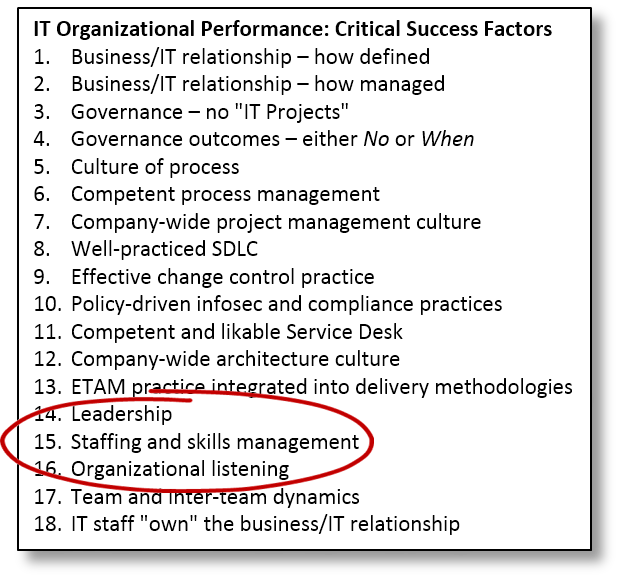
People, process, and technology. It’s the standard formulation for what makes an organization tick. With thirteen of our eighteen IT critical success factors down and only five to go, only two have touched on technology … a company-wide architectural culture and an ETAM practice that’s integrated into IT’s delivery methodologies.

None of the remaining five have anything to do with technology, either. How is this possible? It’s an outrage! After all, isn’t technology IT’s job?

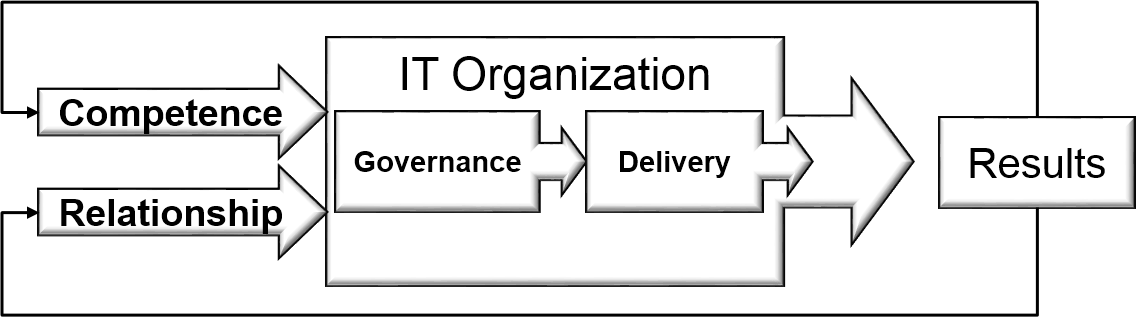
The answer lies in the “results loop” (see figure). For an IT organization, information technology is a result … an output. Critical success factors aren’t about outputs. They’re about the inputs and what turns them into outputs.

And when it comes to what’s needed to turn IT’s inputs into its outputs, there isn’t much that matters more than the people who make information technology happen, and the leaders who make sure they’re the right people with the right skills and focus.

This week’s critical success factors … leadership, staffing and skills management, and organizational listening … have a bit of redundancy to them. After all, as explained in Leading IT: (Still) the Toughest Job in the World (he said in a typically shameless plug), two of the eight tasks of leadership are staffing and communication; organizational listening is part of communication.

To which I plead the Emerson Defense (A foolish consistency is the hobgoblin of little minds; the Emerson in question being, of course, Ralph Waldo).

Organizations live and die on leadership excellence across all eight tasks, which is why I include Leadership on the list.

And yet, the eight tasks (setting direction, delegation, staffing, decision-making, motivation, team dynamics, culture, and communication) aren’t perfectly equal in their impact.

Staffing in particular stands out. Nothing is more important … nothing is even as important … as attracting, hiring, retaining, and promoting the best talent you can find. The proof is simple to state and mathematically precise:

Fact #1: Great employees can overcome bad processes, inadequate tools, ambiguous assignments, and just about any other barrier poor management places in their paths.

Fact #2: Poor employees can make a hash of things, even when working within the most elegantly designed processes, using the best tools money can buy, with clearly formulated assignments and precise specifications.

Inescapable conclusion: Having great employees matters more than anything else you as a leader can influence.

Except … just a few short weeks ago I claimed the business/IT relationship is at the top of the list. What’s the deal, Bob?

Good question. Here’s the answer: First, with great relationships you’ll be forgiven even for employing less than the best. Second, broken relationships are one of the few barriers even great employees can’t overcome. And third, see the Emerson Defense, above.

You need great employees. You need to keep their skills sharp and current. You need to remember that recruiting doesn’t stop when you’ve made a great hire. You should treat your great employees as if you’re recruiting them every day they work in your organization, because if you can’t retain great employees, you’ll never find enough new ones to fill all the empty chairs.

Now that you have great employees, there’s something else you have to do that’s also very important (you know, the CSF thing): You need to know What’s Going On Out There. Why you need to know is, I hope, so obvious it doesn’t need a lot of explanation, but just in case: If you don’t know what’s going on out there, you don’t know what needs your attention, what direction to set, what tasks to delegate, or, for that matter, anything else.

And to know What’s Going On Out There calls for organizational listening — the ability to know what the buzz is; what employees are concerned about; what’s working and what isn’t; who your problem managers are if you have any; what business relationships are damaged or completely broken.

Among other things.

To know What’s Going On Out There calls for a lot of different techniques, ranging from formal employee surveys, to walking around, to informal lunches with groups of employees at all levels, to the chain of command (the least-effective technique).

These techniques share two attributes: None is perfect, which is why you need them all.

And, they all take time.

Find it on your calendar. Because if you don’t, no matter how good a manager you are in all other respects, more often than not you’ll find yourself shooting at the wrong target.

And if you do that, even a bulls-eye is a complete miss.