Hot on the heels of her breakthrough concept for Yahoo! … redesign the home page! … Marissa Mayer made headlines by eliminating telework as her next Big Idea. Best Buy quickly followed suit, leading opinionators from around the country to share their brilliant insights on the topic.

Just in case you’re the sort who requires a 😉 to identify sarcasm, I’m being sarcastic.

Most of these commentators know little or nothing about the subject. You can tell by how many of them talk about telework as if it’s something benevolent employers bestow on lucky employees.

It’s an interesting notion: When an employer gets the same benefits for lower costs, it’s benevolent. And all these years I’ve been using benevolent as a synonym for generous. Now that I know, I’ll reform the rest of my vocabulary too. From now on up means “toward the center of the earth,” dark means “the experience you get looking directly into the sun,” and outside means “working in a corporate cubicle.”

Suggestion: Maybe these opinionators should pay attention to what’s happened in successful turnarounds, rather than in turnarounds-in-progress.

At a minimum, they should have some knowledge about what is and isn’t working well within the halls of Yahoo! and Best Buy.

Me, I have no idea whether Mayer is right or wrong about what Yahoo! needs to do. I don’t have any idea whether Best Buy’s Results Oriented Work Environment (ROWE, and was that the best they could come up with?) was a success or a bust.

What I do know is that there’s nothing to be learned from these decisions. At least, not yet.

Here’s what we do know about telework (and forgive me for repeating myself):

  • Managing teleworkers calls for specific techniques and skills beyond what’s needed to manage employees face-to-face.
  • In particular, without managers who know how to lead remote employees, teleworkers risk becoming second-class corporate citizens.
  • Telework tends to be a better fit for responsibilities assigned to individual contributors than those assigned to teams.
  • When teleworkers are supposed to work as a team, they need support in the form of tools — especially web conferencing tools — techniques, and coaching.
  • Good employees perform better in a telework environment than they do in an office environment. Mediocre-to-poor employees perform worse in a telework environment than they do in an office environment.

Whatever else there is to be said about Marissa Mayer’s decision, she was right about one piece of the puzzle: Before they’re anything else, organizations are collections of relationships, and establishing and maintaining relationships is more difficult for teleworkers than for on-site employees. So if she sees a lot of friction and silos-of-one among employees at all levels at Yahoo!, there’s logic to her action.

And, whatever else there is to be said about her decision, she got one thing excruciatingly wrong (and lots of other commentators have talked about this one, so forgive me for piling on):

In its chapter on motivation, Leading IT identifies three outstanding ways to demotivate employees: Arrogance, disrespect, and unfairness.

When Mayer announced she was eliminating telework, it came out that at the same time she was building a nursery next to her office. That’s supposedly okay because she did it at her own expense.

To which, before getting back to the main point, may I just ask, and you fell for that?

Mayer is only building it at her own expense if she pays rent to Yahoo! every month at the going rates for the square footage her nursery occupies. Thus far I’ve yet to read that this is the case.

So back to the three demotivators. Arrogance? No, this decision wasn’t arrogant, whatever else it was. Disrespect? Not really. Mayer didn’t accuse teleworkers of slacking. She said she wants everyone face-to-face to provide the sparks of creativity that happen better that way.

But unfairness? Bingo. Anatole France put it nicely a long time ago: “The law, in its majestic equality, forbids the rich as well as the poor to sleep under bridges, to beg in the streets, and to steal bread.”

Even if Mayer allowed every employee to build out nurseries next to their cubicles, with Yahoo! providing the space, she still wouldn’t have a leg to stand on. Her enormous personal wealth and compensation see that.

But she doesn’t, so she’s just another example of privilege, which as Terry Pratchett pointed out in one of his fine Discworld books, literally means “private law.”
Humans are the collaborating animal.

Sure, bees dance, termites build mounds, and wolves and orcas hunt in packs. But no other animal gets together to build anything on the level of skyscrapers or Mars rovers, to fight in anything resembling a human armed force, or compose and then sing barbershop quartets, let alone symphonies.

But for every successful collaboration there are probably ten that fail, whether they’re ERP implementations, failed designs for a 9/11 memorial, most legislation, or every Pirates of the Caribbean sequel and every other Disney-theme-park-ride-turned-into-a-movie.

What goes wrong? With Disney, it’s probably the need to manufacture another movie even if nobody has had even a tiny spark of inspiration to justify one. For the rest …

Often, the problem comes down to different people from different organizations coming to the party with different hidden assumptions. When these go undetected and unresolved, the usual outcome is something less than success.

Two weeks ago we looked at one aspect of the situation: How each party values the three bottom-line goods of business — revenue, cost, and risk.

Last week we looked at a second aspect of it: How organizational styles compare, and in particular their levels of empowerment, formality, and communication.

This week we look at one more aspect: Each organization’s operating mode.

At the risk of oversimplifying, organizations have three ways to do their work.

The first is to work through processes and procedures, which is to say recipes. Everything is specified, and if everyone just follows the steps as they’re described, the result will be what it’s supposed to be.

The second is to work in accordance with “practices.” Like processes, practices are organized into an accepted series of steps to follow. Unlike processes, in a practice the specifics are left to the practitioners, who are expected to apply their knowledge, experience, and judgment to each situation they face.

The third is to innovate and improvise — to figure things out based on the logic and context of each situation.

The way it ought to be is that for each type of work that has to get done, the organization responsible for it makes a conscious choice from among these three ways of working, recognizing that really, they aren’t categories so much as they’re three poles in a continuum of possibilities.

The way it usually does work is that for each type of work, whoever does it chooses whichever approach they like the best — the decisions come from hidden assumptions, not explicit analysis.

Likewise IT. So when the two organizations try to collaborate, their two sets of preferences don’t line up, because why would they?

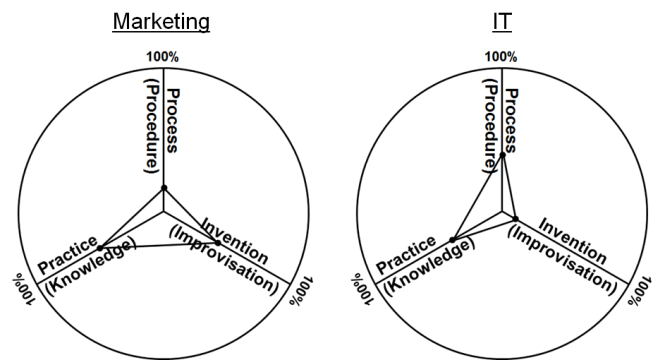
Imagine, just for the sake of argument, that IT’s overall operating mode strikes an even balance between process and practice, with very little improvisation going on.

Now imagine the other organization IT has to collaborate with is Marketing. As the figure illustrates, our mythical Marketing organization is heavy on practice and improvisation. Following recipes just isn’t in its DNA.

Now what?

The starting point is to be conscious: of your own organization’s preferences, and those of the organization you’ll be collaborating with. How can you find out?

Ask. Not using this vocabulary, which might seem strange to anyone who doesn’t read Keep the Joint Running. But just asking, as in, “Tell me about the kinds of work you do here.”

As you listen, keep an ear out for key phrases like, “We just do what makes sense,” a tip-off that improvisation is important there. Or, “This is how we do things around here,” which sounds a lot like process.

“We know our business and get the job done”? That’s a practice orientation.

It will take some conversation, some reading between the lines, and eventually, perhaps, after you’ve built some rapport, some time spent familiarizing your colleagues in Marketing (or wherever) with these concepts. At some point in the conversation you’ll familiarize your colleagues with your IT self-assessment, and you can ask for their self-assessment.

Better yet, you’ll be able to discuss why IT is what it is and why Marketing is what it is.

That’s when both organizations will stop choosing their operating mode based on personal preference and start deciding based on the logic of their (and your) circumstances.

Once you’ve achieved that, you’ll be in a very good position to help your colleagues solve the problems they have in ways that will fit their operating mode, rather than trying to force-fit them into yours.

That’s preferable for a very simple reason: If your solutions fit their operating mode, they might actually adopt them.